Private German rocket makes history, reaches orbit from European soil
No rocket had ever reached orbit from Western European soil — until today.
5 min read

Executive DigestOriginal Reporting by Space.com
This is a curated overview of the story reported by Space.com. Full text remains copyright of the publisher.
Read Full Story on Space.com →No rocket had ever reached orbit from Western European soil — until today.
The German company Isar Aerospace launched its Spectrum rocket from Andøya Space Center in northern Norway today (Sept. 5) at 4:12 p.m. EDT (2012 GMT; 10:12 p.m. local time in Norway). A little over seven minutes later, it etched its name into the record books, settling into an elliptical path around our planet.
"This is right now making history — making history for Spectrum, making history for Isar, making history for Europe,” Nikolaos Perakis, Spectrum chief engineer at Isar, said during today's launch webcast, which the company produced in collaboration with NASASpaceflight. "I'm incredibly proud of this massive achievement."
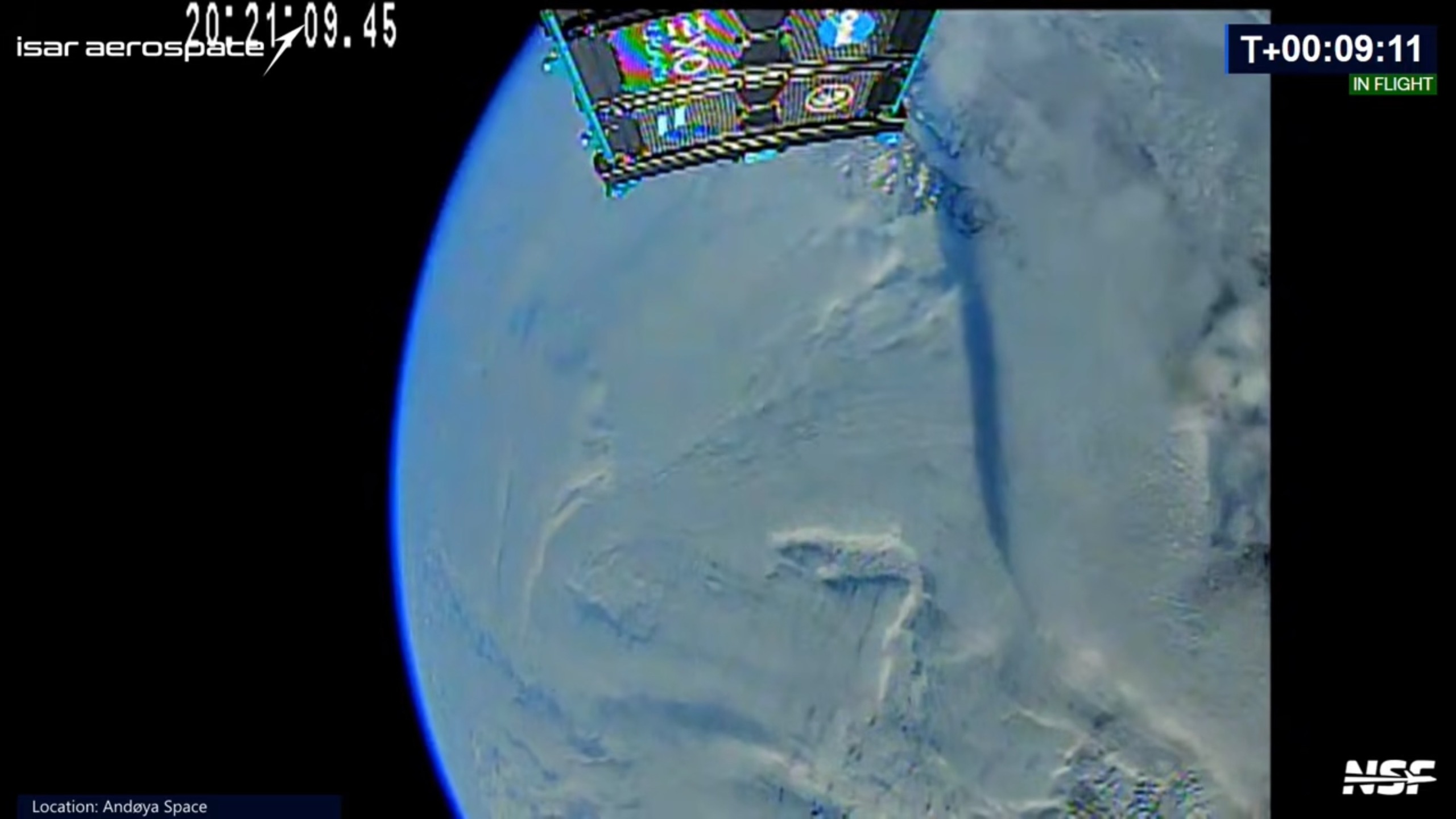
This was Spectrum's second bite at the apple: The two-stage, 95-foot-tall (28-meter-tall) rocket first flew in March 2025, lifting off from Andøya on a flight Isar called "Going Full Spectrum." But, as often happens on debut missions, Spectrum suffered an anomaly that day; it came crashing back to Earth less than a minute after launch.
"A comprehensive investigation was completed within two months of the launch," Isar wrote in a September 2025 update. "The findings identified an unintended opening of the vent valve and a loss of attitude control at the start of the roll maneuver as the initiating events that led to the in-flight failure."
The company took the lessons learned that day and geared up for flight number two, "Onward and Upward," which was originally supposed to launch in January.
An issue with a pressurization valve nixed that plan, however, pushing the flight to March. Bad weather and an intruding boat scuttled multiple attempts that month, and an April 9 try was scrubbed due to a leak in a composite overwrapped pressure vessel.
Isar next tried to fly on June 15 but stood down after "detecting off-nominal behavior in the vehicle's fluid systems," according to a company update that day on X. But the company got that issue under control, rolling Spectrum back to the pad for today's launch.
"We had some delays, obviously," Petrakis said during the webcast. "We had some setbacks, but we came back stronger from them. And it validates this tremendous amount of engineering across all the teams, and that's what brings us into orbit."
Spectrum didn't carry viable payloads on its debut flight, but it did today: Five cubesats and one non-deployable scientific experiment went up on "Onward and Upward."
Spectrum's upper stage needs to deploy those payloads before Isar can declare full mission success. And deployment won't occur until after the rocket performs a circularization burn to get out of its initial elliptical orbit, which was estimated to feature a closest approach to Earth of 112 miles (180 kilometers) and a farthest-away point of 311 miles (500 km).
Whether or not Spectrum checks those boxes, today was a big day for Isar, which is thinking big with Spectrum. The company sees the rocket — which can haul about 2,200 pounds (1,000 kilograms) of payload to low Earth orbit — becoming a workhorse launcher of small to medium-size satellites down the road, and its infrastructure supports that vision. Isar says its manufacturing facility near Munich can churn out more than 30 of the rockets per year.
“Flight 2 is a big, big milestone, big success," Petrakis said. "But this is just the beginning. So I'm really looking forward to the next steps."
Spectrum is the first rocket to reach orbit from Western Europe, but others have long flown from a different part of the continent — the Russian part. For example, Plesetsk Cosmodrome has hosted orbital launches for about six decades now. (About 25% of Russia lies in Europe, with the rest classified as part of Asia.)
Editor's note: This story was updated at 4:45 p.m. ET with news of successful launch and orbital insertion.
00
Related Articles

Phys.org·16h ago·Science
High-resolution weather data could pinpoint neighborhoods facing greatest heat stress
Heat stress is a leading cause of weather-related deaths and can be especially dangerous in cities, where phenomena like urban heat islands drive temperatures higher than in surrounding rural areas. Now, a new dataset developed by the U.S. National Science Foundation National Center for Atmospheric…

Phys.org·17h ago·Science
New species of 240-million-year-old prehistoric animal could reshape dinosaur origins timeline
A new prehistoric animal species from Tanzania dating to around 240 million years ago, during the Triassic period, has been described by an international team of researchers. Led by the University of Bristol, the new species, named Dinodontosaurus isiyavamanda, could help scientists refine the age o…

Phys.org·17h ago·Science
Weather forecasts are significantly less accurate in poorer countries, analysis finds
Weather forecasts inform countless everyday decisions—from farmers deciding when to sow crops and energy companies anticipating demand to public authorities preparing for heat waves. But how useful those forecasts are depends considerably on where people live.

Phys.org·17h ago·Science
Young, eco-anxious Canadians are the most likely to support disruptive tactics by environmental activists, study finds
The tolerance of individual Canadians for radical forms of environmental activism depends on several factors. Overall, however, Canadians do not support vandalism or violence as forms of protest. Those are the key findings of a new study by researchers from McGill University and Université Laval. Th…